
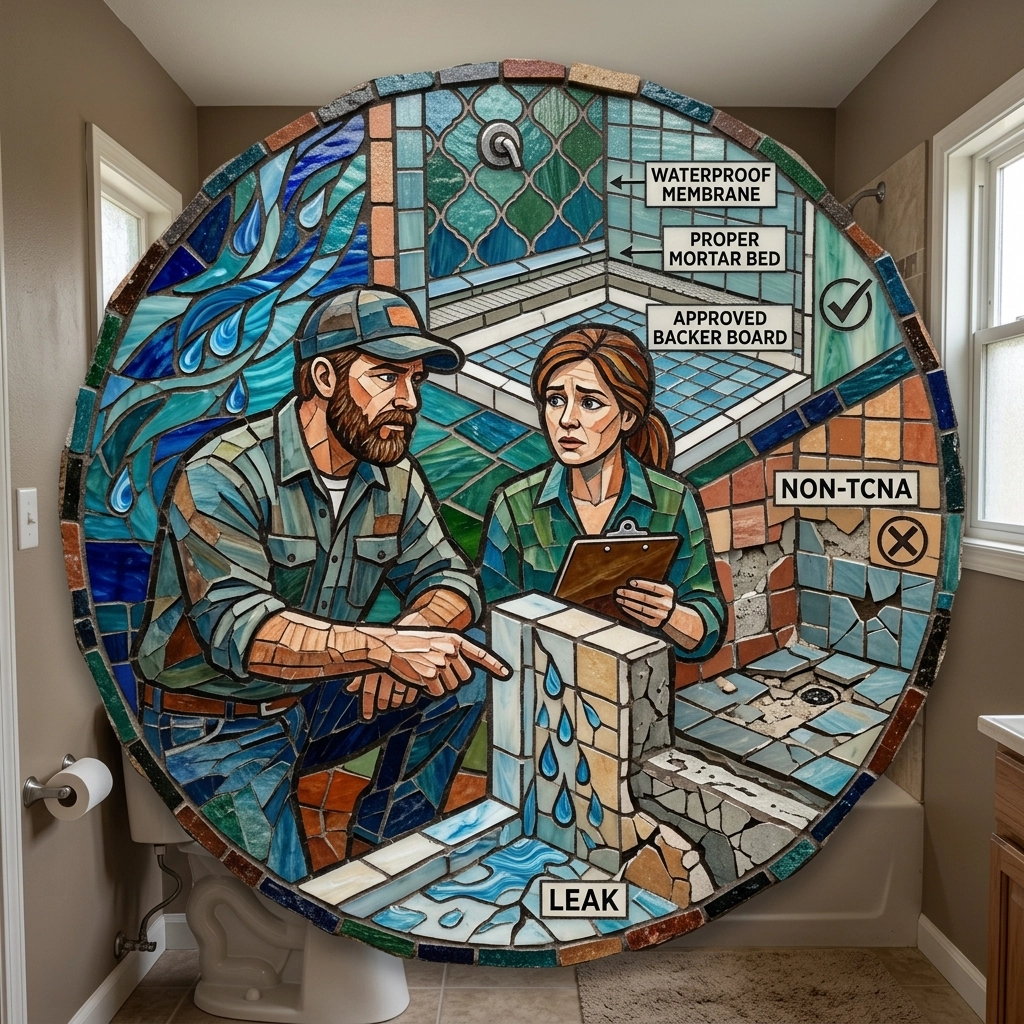
For Colorado homeowners, a leaking new shower is more than a frustration. It is a costly failure made worse by the realities of our region. You spent weeks, perhaps months, dreaming of that morning ritual: the steam rising against hand-selected glass, the rhythmic patter of water against a pebble floor. But then, a damp spot appears on the ceiling below. A baseboard begins to swell. The dream dissolves into demolition, repair, and the nagging question of what was missed behind the tile.
At The British Remodeler, we view a shower not merely as a functional utility, but as a vessel built to withstand water, movement, and time. That matters even more here in Colorado Springs and the surrounding mountain-edge communities. In places like Woodland Park and Monument, freeze/thaw cycles, dry air, seasonal expansion, and shifting soils put assemblies under stress. Water is a patient ghost; it will find the tiniest oversight, the smallest structural sigh, and turn it into a catastrophe.
To prevent this, we adhere to the strict liturgical texts of our industry: the TCNA (Tile Council of North America) Handbook. These are not "suggestions." They are the non-negotiable laws of physics and chemistry applied to tile. When we discuss shower remodeling in Colorado Springs, we aren't just talking about aesthetics; we are talking about building systems that can handle local movement, climate pressure, and the demands of daily use without leaking.
Here are the seven reasons your new shower might be failing you, and why TCNA standards are the only path to a lifetime of dry subfloors in Colorado.
1. The Invisible Canvas: Waterproofing Membrane Failures
Many installers treat tile as the waterproof layer. This is a fundamental misunderstanding of the material's soul. Tile and grout are, by nature, porous. They breathe. They allow moisture to pass through. The true shower lives beneath the tile.
TCNA standards mandate a continuous, unbroken waterproofing system. Whether it is a liquid-applied membrane that cures into a rubberized skin or a bonded sheet membrane, it must be Flawless. We often see failures where the membrane was applied too thin: a "ghost coat": or where the transition between the wall and the floor wasn't properly reinforced.
"Waterproofing is the silent heartbeat of the shower. If it stops, the whole body dies."
When we build, we treat the waterproofing as the final product. We flood test it. We let the "basin" hold water for 24 hours before a single tile is laid. If the water level drops even a fraction of an inch, we find the "why" before we move forward.

2. The Gravity Betrayal: Improper Pre-Slope
Gravity is the most honest collaborator we have. It never lies. In a traditional mortar bed shower, TCNA standards require a "pre-slope" underneath the waterproof liner.
A common, devastating mistake is laying the liner flat on the subfloor and then sloping the mortar on top of it. This creates a "stagnant pond" inside your floor. The water migrates through the grout, hits the flat liner, and just sits there. It becomes a breeding ground for bacteria and eventually rots the wooden framing. TCNA requires a slope of 1/4" per foot toward the drain. We ensure the water is always moving, always guided toward its exit.
3. The Thinset Myth: Poor Coverage and "Spot Bonding"
There is a lazy practice in the industry known as "spot bonding" or "five-spotting," where a contractor places dollops of thinset on the corners and center of a tile rather than troweling the whole surface.
In a wet environment, this is a death sentence. TCNA standards for TCNA standards shower construction require 95% coverage in wet areas. Why? Because those hollow voids behind the tile act as tiny caves where moisture collects, minerals deposit (efflorescence), and the bond eventually fails. We use the "collapse the ridges" technique, ensuring the tile and the substrate become one singular, solid mass.
4. The Dance of the House: Ignoring Structural Movement
Homes are living things. They expand in the heat of a Colorado summer and contract in the dry chill of winter. If a shower is built as a rigid box, it will crack.
TCNA Standard EJ171 governs expansion joints. We see showers leaking because the installer grouted the vertical corners where two walls meet. Grout is rigid; it cannot move. When the house "shrugs," that grout cracks, creating a vertical highway for water to enter the wall cavity. We treat these corners as "movement joints," using high-quality silicone that matches the grout's color but possesses the elasticity to dance with the home’s rhythm.

5. The Bottleneck: Improper Drain Integration
The connection between the waterproofing membrane and the drain is the most technically demanding square inch of the entire project. If the flashing is not integrated correctly, or if the "weep holes" in the drain assembly are clogged with mortar, the system backs up.
We treat the drain as a sacred junction. We use integrated bonding flanges that allow the waterproofing to be chemically or mechanically bonded directly to the drain unit. This creates a seamless transition that defies the very idea of a "leak."
6. The Threshold Failure: The Vulnerable Curb
The curb is the gateway. It is where most people step, putting immense pressure on the waterproofing. If a contractor nails a wooden 2×4 curb and then pierces the waterproof liner with nails to attach the cement board, they have just created a dozen tiny leaks.
We prefer "curbless" designs or solid-core curbs that require no penetrations. By treating the curb as a monolithic structure, we ensure that the transition from the wet zone to the dry zone is an impenetrable fortress. You can learn more about our approach to bespoke shower floors in our guide to glass underfoot.
7. The Puncture: Valve and Pipe Penetrations
Every time we cut a hole for a mixing valve, a showerhead, or a handheld sprayer, we are compromising the waterproofing. TCNA standards demand that these penetrations be sealed with specialized gaskets or waterproof caulking.
Too often, these holes are left raw behind the decorative escutcheon plate. Water that runs down the wall and behind the handle finds an open door into the wall. We seal these "vulnerable nodes" with the same reverence we give the floor itself.

The Philosophy of the Permanent
Why go to such lengths? Why obsess over the "hidden" parts of the build?
At The British Remodeler, we don't just build showers; we build legacies. This is where our dual-brand philosophy becomes clear. The British Remodeler is the name we carry into bathroom remodeling, shower construction, tile work, flooring, and the structural discipline that keeps a home dry, sound, and lasting. The Glass Lion is the fine art and mosaic lore: the more luminous, story-rich side of our work where hand-shaped glass, murals, and bespoke artistic installations take the lead. Together, they share the same hands, the same standards, and the same respect for materials, but each name serves its own purpose.
So when we are discussing TCNA shower construction, waterproofing, slope, movement joints, and drain integration, we are speaking as The British Remodeler. When a project moves into custom mosaic storytelling or landmark glass art, that creative current belongs to The Glass Lion. The craftsmanship is continuous. The expression simply changes shape.
When you follow TCNA standards, you aren't just following rules; you are respecting the materials. You are acknowledging that stone, glass, and water have their own behaviors, and your job is to harmonize them.

Your Vision, Our Precision
A shower should be a sanctuary, not a source of anxiety. If you are planning a shower remodeling project in Colorado Springs, Woodland Park, Monument, or nearby communities, don't settle for "good enough." Demand the forensic precision of the TCNA standards. In Colorado, local soil movement and repeated freeze/thaw cycles can expose every shortcut. A shower built without proper slope, movement accommodation, waterproofing, and drain integration may look finished on day one and begin failing long before it should.
We invite you to view our gallery to see the range of work shaped under The British Remodeler and, where art takes the lead, the visual language of The Glass Lion. For remodeling, tile bathrooms, custom concrete shower pans, flooring, and bathroom construction, The British Remodeler is the name to know. For fine art mosaics, glass shard murals, and the deeper lore of handcrafted surface art, The Glass Lion carries that banner.
Let’s start a conversation.
If you are ready to build a shower that respects Colorado’s climate as much as your design vision, reach out to us. Let’s discuss your project and how our forensic precision and artisan mastery can bring it to life.
Leave a Reply